Our answer
Choose Jackery when a 39.5 lb body and a published 4,400W peak suit the load. Choose BLUETTI when 2,600W continuous output, 1,000W solar input, and a 6,000-cycle retention claim outweigh its 53.4 lb weight and lack of a general surge figure in this record.
Portability versus solar throughput
Jackery is 13.9 lb lighter. That difference is substantial when the station moves between a vehicle, storage area, and outage setup.
BLUETTI accepts up to 1,000W of solar within its documented voltage and current envelope. Jackery's official page presents a two-panel 400W solar configuration. Real recharge still depends on panel conditions.
Output needs a load-specific reading
Jackery publishes 2,200W continuous and 4,400W peak. BLUETTI publishes 2,600W continuous, while its 3,900W Power Lifting mode is limited to pure resistive loads and is not counted as motor surge.
For a pump or compressor, Jackery has the clearer published starting envelope. For a sustained resistive or mixed load below 2,600W, BLUETTI has more continuous headroom.
Battery-life claims use different thresholds
Jackery states 4,000 cycles to at least 70% capacity. BLUETTI states 6,000 or more cycles to 80%. Compare both the cycle count and the retained-capacity threshold rather than the number alone.
Source-reviewed candidates
Compare the relevant product records
| Product and use | Capacity | Continuous AC | Peak AC | Weight | Direct manufacturer |
|---|---|---|---|---|---|
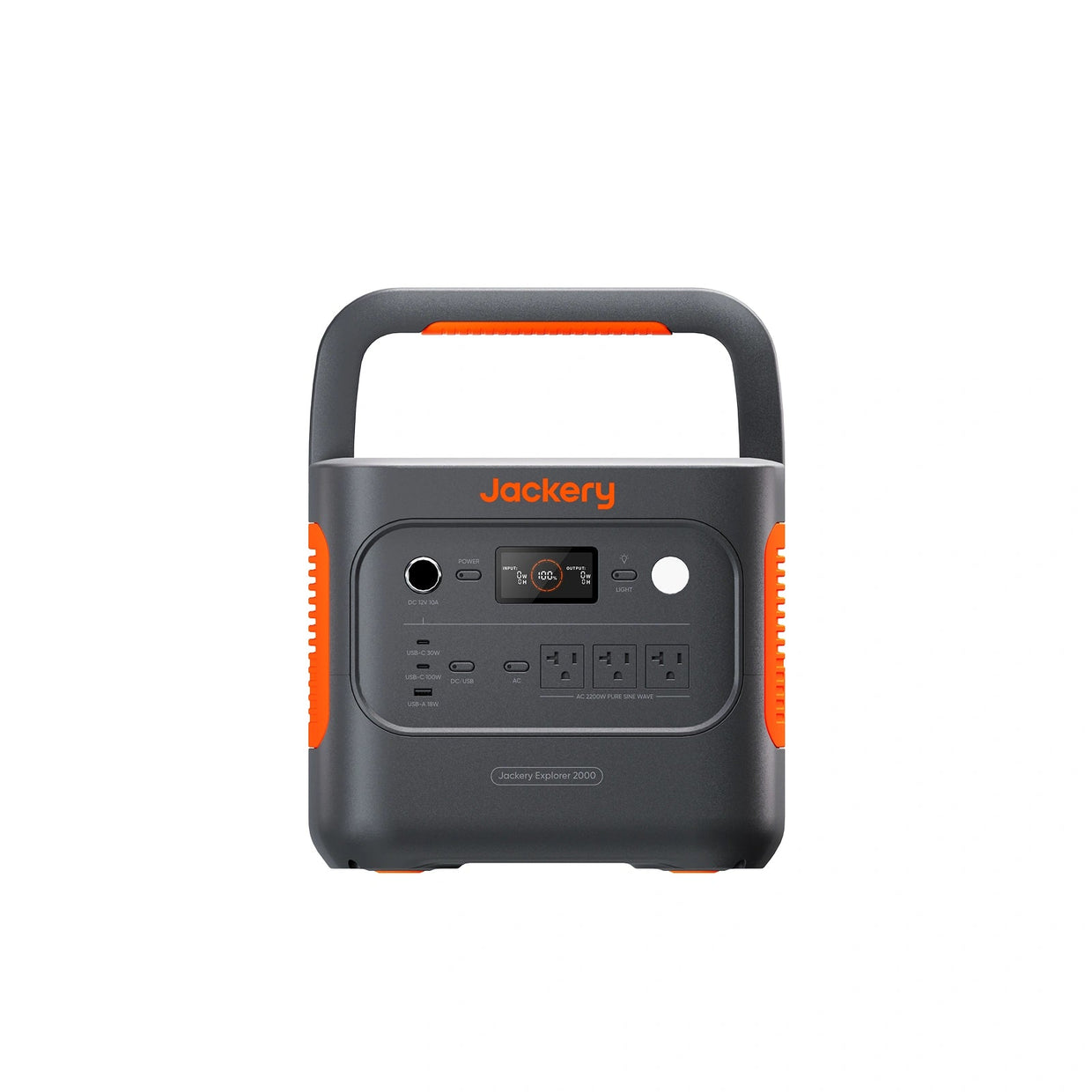 | 2,042 Wh | 2,200 W | 4,400 W | 39.5 lb | Check Jackery |
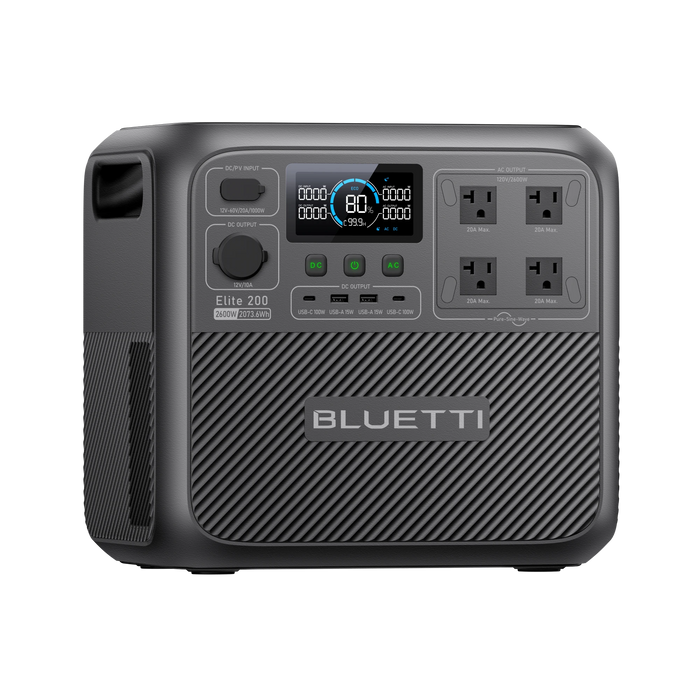 | 2,073.6 Wh | 2,600 W | Not published | 53.4 lb | Check BLUETTI |
Manufacturer boost modes are not substituted for a general surge rating. Direct manufacturer links exclude Amazon.
Continue through this cluster
Use the next page that answers your unresolved constraint
Evidence used on this page
Important fields are tied to a specific source. Manufacturer claims, government guidance, calculations, and planning assumptions remain separate.
- Calculation and compatibility methodology
Power Station Station
Defines capacity, efficiency, reserve, duty-cycle, voltage, continuous-output, and startup checks used across the site.
planning assumption
- Explorer 2000 v2 specifications
Jackery US
US model page. Capacity, output, peak, chemistry, cycle claim, weight, solar pairing, UPS, and warranty checked.
official product page
Capacity, chemistry, cycle-life claim, and warranty checked.
official product page
- Elite 200 V2 user manual
BLUETTI
AC output, solar envelope, weight, UPS transfer time, and Power Lifting limitation checked.
official manual