Our answer
3 of the 8 catalogued panels clear every check against the Goal Zero Yeti 500. The most it will take from a single cleared panel is 100W, from either the Goal Zero Nomad 100 or the Goal Zero Boulder 100 Briefcase. 4 panels are blocked outright, most often on input current rather than voltage.
Matching watts is not a compatibility answer
A 200W solar input does not mean any panel up to 200W will work. Four separate things have to line up: the panel must operate inside the station's voltage window, it must stay under the ceiling when cold weather pushes its voltage up, its current must sit inside the input limit, and the plug must match or be adapted safely.
The table runs all four checks for the Goal Zero Yeti 500. A pairing fails if it fails any one of them, and the reason is stated rather than reduced to a score.
| Panel | Rated | Vmp / Voc | Output current | Station accepts | Verdict |
|---|---|---|---|---|---|
| Goal Zero Nomad 50 | 50W | 18V / 21.5V | 3.3A rated | 50W | Clears every check |
| Goal Zero Nomad 100 | 100W | 18V / 21.5V | 5.9A short-circuit | 100W | Clears every check |
| Goal Zero Boulder 100 Briefcase | 100W | 17.2V / 21.5V | 7A rated | 100W | Clears every check |
| Goal Zero Boulder 100i | 100W | 17.1V / 20.52V | 6.14A short-circuit | 100W | Check before relying on it |
| Goal Zero Nomad 200 | 200W | 19.1V / 23V | 14A rated | 200W | Do not connect directly |
| Goal Zero Boulder 200 Briefcase | 200W | 18.1V / 21.8V | 14A rated | 200W | Do not connect directly |
| Goal Zero Ranger 300 Briefcase | 300W | 19.3V / 23V | 21A rated | 200W | Do not connect directly |
| Goal Zero Nomad 400 | 400W | 20.66V / 23.84V | 20.45A short-circuit | 200W | Do not connect directly |
The "station accepts" column is the panel rating capped by the station input ceiling. It is not a prediction of what a panel produces in real sunlight.
Why 4 panels are blocked
These are not marginal cases. Each one breaches a published limit, so connecting it directly either risks the charge controller or simply will not charge.
- Goal Zero Nomad 200: The panel can deliver 14A rated output current, above the station's 10A limit.
- Goal Zero Boulder 200 Briefcase: The panel can deliver 14A rated output current, above the station's 10A limit.
- Goal Zero Ranger 300 Briefcase: The panel can deliver 21A rated output current, above the station's 10A limit.
- Goal Zero Nomad 400: The panel can deliver 20.45A short-circuit current, above the station's 10A limit.
What stays unresolved on one panel
None of these is a failure. They are pairings where a specification the manufacturer never published leaves a check open, so the honest answer is that it cannot be settled from the data, not that it is fine.
- Goal Zero Boulder 100i: The panel terminates in MC4 and the station input is 8mm. An adapter is needed, and it must carry the full current with correct polarity.
Running more than one panel
Wiring panels in parallel adds current at the same voltage, so the input current limit decides how many this station will take.
No series figure is given below. Series wiring is limited by cold-weather voltage, and without a published temperature coefficient that cannot be calculated honestly.
- Goal Zero Nomad 50: up to 3 in parallel, no series figure without a temperature coefficient.
- Goal Zero Nomad 100: no room for a second one in parallel, no series figure without a temperature coefficient.
- Goal Zero Boulder 100 Briefcase: no room for a second one in parallel, no series figure without a temperature coefficient.
How long these panels take to fill the pack
The Goal Zero Yeti 500 holds 499.2Wh. The hours below divide that by the charging watts the station actually accepts, after an 80% planning efficiency for ordinary conversion and cable loss.
Ideal hours assume that input is sustained, which sunlight does not do. The daily column is more useful for planning: it applies 5 peak sun hours, a common figure for a clear day, to show how much energy a panel realistically returns between sunrise and sunset.
| Panel | Station accepts | Ideal charge time | Energy on a clear day |
|---|---|---|---|
| Goal Zero Nomad 50 | 50W | 12.5 h | 200 Wh |
| Goal Zero Nomad 100 | 100W | 6.2 h | 400 Wh |
| Goal Zero Boulder 100 Briefcase | 100W | 6.2 h | 400 Wh |
Calculated, not measured. Charge taper, panel angle, temperature, shade and cloud all extend a real session, and a battery near full charges more slowly than these figures suggest.
What these checks do not settle
Every gap below is a specification a manufacturer chose not to publish, followed by the panels it affects. None is filled with an estimate, because each one feeds a check that exists to protect hardware.
- Goal Zero does not publish a short-circuit current for the panel. Goal Zero Nomad 50, Goal Zero Boulder 100 Briefcase
- Series configurations cannot be recommended without a cold-weather voltage figure. Goal Zero Nomad 50, Goal Zero Nomad 100, Goal Zero Boulder 100 Briefcase, Goal Zero Nomad 200, Goal Zero Boulder 200 Briefcase, Goal Zero Ranger 300 Briefcase
- The pairing needs an adapter from MC4 to 8mm, which neither manufacturer supplies as a tested combination. Goal Zero Boulder 100i
- Without a published temperature coefficient, the cold-weather voltage rise cannot be checked, and on this pairing the margin is too thin to dismiss. Goal Zero Nomad 200, Goal Zero Ranger 300 Briefcase
Source-reviewed candidates
Compare the relevant product records
| Product and use | Capacity | Continuous AC | Peak AC | Weight | Direct manufacturer |
|---|---|---|---|---|---|
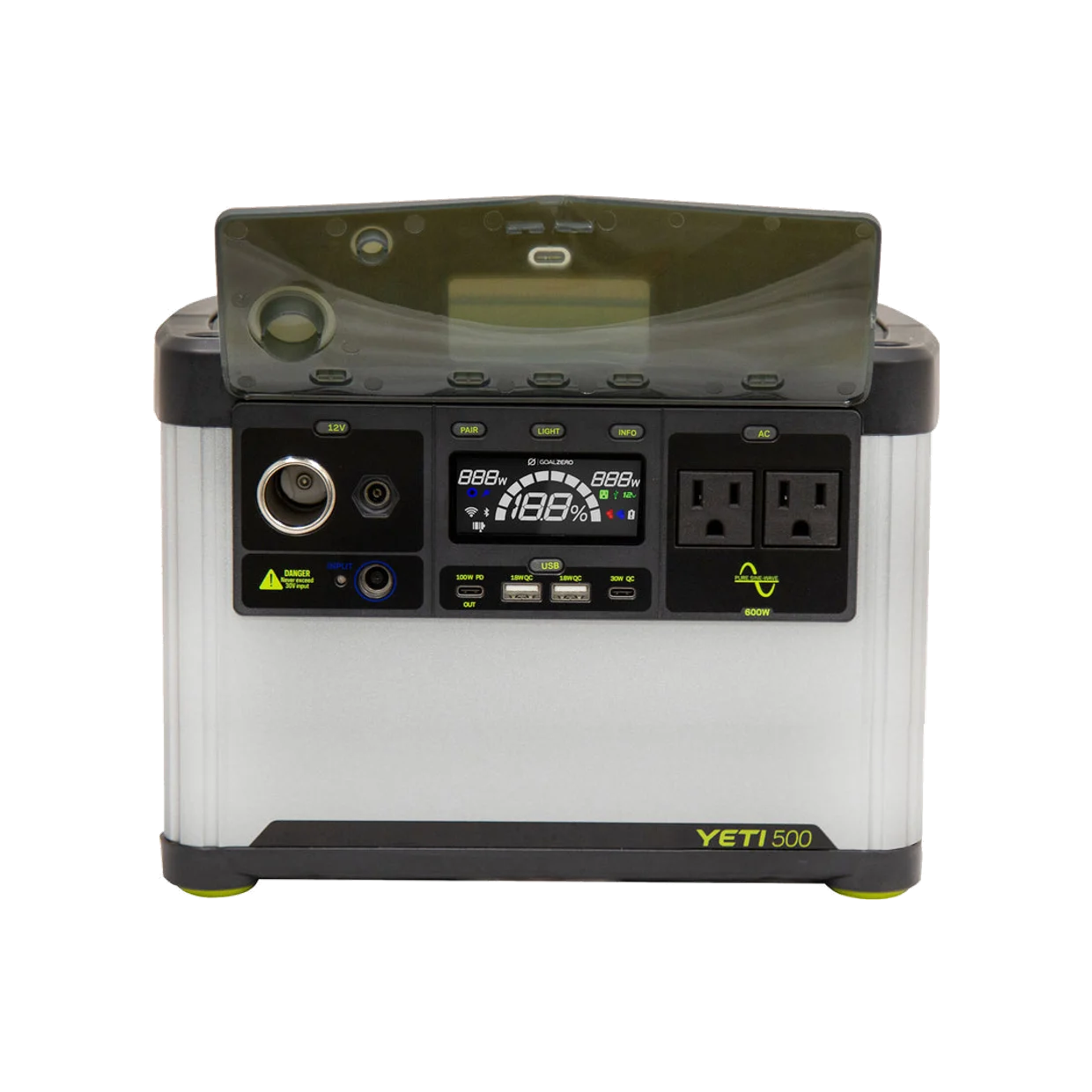 | 499.2 Wh | 500 W | 1,000 W | 16.1 lb | Check Goal Zero |
Manufacturer boost modes are not substituted for a general surge rating. Direct manufacturer links exclude Amazon.
Questions that change the decision
Can I use any 200W solar panel with the Goal Zero Yeti 500?
No. The 200W figure is a ceiling on power, not a statement of compatibility. A panel also has to operate between 12.3V and 28V, stay under that ceiling when cold, and keep its current inside the station's input limit. A panel can match on watts and still fail all three.
Why does cold weather matter for solar panel voltage?
Open-circuit voltage rises as temperature falls. A panel measured at 25°C can sit comfortably inside an input window and still exceed it on a cold, bright morning, which is the most common way a watts-matched pairing damages a charge controller. Where a panel publishes a temperature coefficient the rise is calculated here; where it does not, the page says the check is open rather than assuming a value.
Does an adapter make a mismatched connector safe?
Only if it carries the full current with correct polarity, and neither manufacturer sells the combination as a tested pair. A connector mismatch is flagged here as something to resolve, not as a pass.
Continue through this cluster
Use the next page that answers your unresolved constraint
Evidence used on this page
Important fields are tied to a specific source. Manufacturer claims, government guidance, calculations, and planning assumptions remain separate.
- Goal Zero YETI 500 specifications
Goal Zero
Published specification table covering capacity, chemistry, lifecycles, inverter output, solar input window, weight, and warranty.
official product page
Published specification table: inverter output and waveform, every DC and USB port with its rating, the solar input window and current limit, AC charge input, and expansion.
official product page
- Goal Zero Nomad 50 specifications
Goal Zero
Published specification table: rated power, open-circuit voltage, maximum power point voltage, the output port voltage window and current ceiling, weight and warranty.
official product page
- Goal Zero Nomad 100 specifications
Goal Zero
Published specification table: rated power, open-circuit voltage, maximum power point voltage, the output port voltage window and current ceiling, weight and warranty.
official product page
Published specification table: rated power, open-circuit voltage, maximum power point voltage, the output port voltage window and current ceiling, weight and warranty.
official product page
Published specification table: rated power, open-circuit voltage, maximum power point voltage, the output port voltage window and current ceiling, weight and warranty.
official product page
- Goal Zero Nomad 200 specifications
Goal Zero
Published specification table: rated power, open-circuit voltage, maximum power point voltage, the output port voltage window and current ceiling, weight and warranty.
official product page
Published specification table: rated power, open-circuit voltage, maximum power point voltage, the output port voltage window and current ceiling, weight and warranty.
official product page
Published specification table: rated power, open-circuit voltage, maximum power point voltage, the output port voltage window and current ceiling, weight and warranty.
official product page
- Goal Zero Nomad 400 specifications
Goal Zero
Published specification table: rated power, open-circuit voltage, maximum power point voltage, the output port voltage window and current ceiling, weight and warranty.
official product page